
Builder Payment Schemes, Decoded: 20:80, 10:90, Subvention and CLP
“Pay 10% now, the rest at possession” is leverage rented from the builder. On a ₹1 crore flat, a 20:80 plan holds the flat for about ₹22 lakh and, if prices grow 6% and you resell before handover, returns about 12.4% a year on your cash against 6.8% on a construction-linked plan. The same plan turns negative if prices barely move. We explain six payment structures, what the premium really costs (about 6.5% to 7.6% a year), why bank-funded subvention is the one to avoid, and the twelve checks to make before you sign.
Investment Research Desk
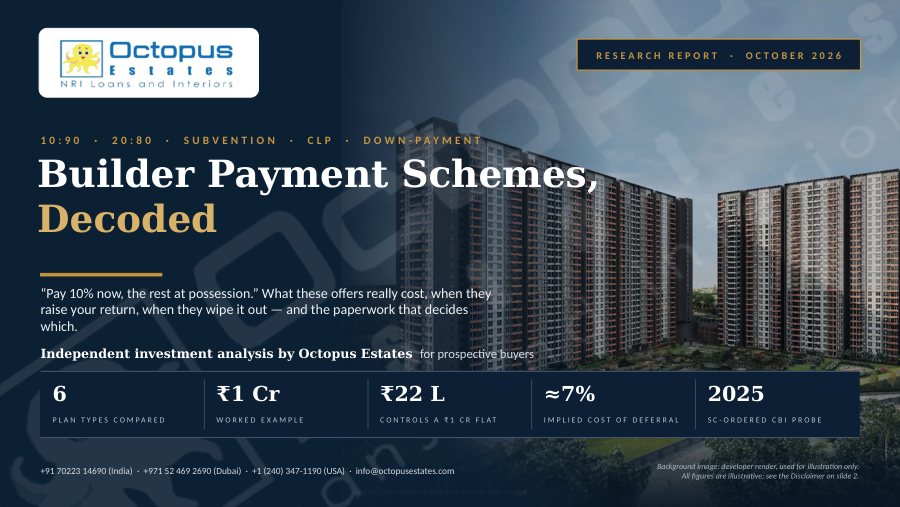 Free PDF28 pages · 1.7 MB
Get the full 28-page report
This article is the summary. The report holds the detailed numbers, tables and checklists behind every claim.
- Six payment structures compared on one ₹1 Cr flat
- Cash-out, leverage and price-growth sensitivity charts
- A 30-term plain-English glossary
- Twelve checks before you sign and six things to negotiate
Free. No sign-up. Save it or share it with your advisor.
The short answer
A builder's "pay later" plan is a small loan from the developer, priced into the flat. It is worth taking when that loan is cheap, the project is safe and your exit is clear. It is a trap when the loan is really a bank's, in your name, and someone else is supposed to pay it.
On a ₹1 crore flat, a 20:80 plan needs about ₹22 lakh in cash before possession. If prices grow 6% a year and you assign the booking before handover, your return on that cash is about 12.4% a year, against 6.8% on a construction-linked plan for the same flat. But if prices rise only 3%, the same 10:90 plan loses about 11.8% a year on your deposit. Small deposit, big swings, both ways.
The idea in one picture
Think of reserving a car: a small token now, the rest on delivery, but the showroom charges a little extra for waiting.
- Today: pay 10% to 20% (₹10 to 22 lakh on a ₹1 crore flat) and sign the Agreement for Sale.
- The next two to four years: the builder builds, and your remaining money can stay in the bank or other investments.
- At handover: pay the 80% to 90% from savings or a home loan, register the flat and take the keys.
- Or, before handover: if the agreement allows, assign your booking to a new buyer and keep the price rise.
Buyers like it because they keep their cash longer, do not pay rent and EMI together during construction, and get the price rise on the whole flat. The flat usually costs 3% to 10% more, you still need the big payment at the end, and if prices do not rise your small deposit can shrink fast.
Six ways to pay for an under-construction home
Names vary by developer ("Live Lite", "Pay Less Now", "No EMI till possession") but almost every offer is one of six structures.
| Plan | How it works | Typical price effect |
|---|---|---|
| Construction-linked (CLP) | 10% to 20% at booking, the rest in slabs as floors are cast. The default plan and the reference price | Reference price |
| Down-payment (DPP) | 90% to 95% within 30 to 60 days | About 5% to 10% discount; best value if the developer is safe |
| Possession-linked (10:90, 20:80) | 10% to 20% now, the balance at OC or possession | Often 3% to 10% above CLP |
| Subvention / no pre-EMI | A bank disburses most of your loan to the builder upfront; the builder pays the interest until possession. A tripartite agreement makes you liable if it stops | Premium of around 6% |
| Time-linked / flexi | Fixed dates (for example every six months) regardless of progress, sometimes mixed with CLP or a possession-linked tail | Varies |
| Assured return / rental | The builder pays a fixed "return" or rent until possession. Effectively a disguised discount, and a credit risk | Varies |
What you really pay, and what you really earn
Take one ₹1 crore flat bought on a 20:80 plan and sold just before handover, three years later.
- You pay now: ₹20 lakh (20%); the other 80% waits until handover.
- After three years at about 6% growth: the flat is worth about ₹1.18 crore, a gain of ₹18 lakh on the whole flat, roughly 90% of your cash before costs.
- Then subtract the real costs: about 5% extra price for the 20:80 plan, 5% GST on what you paid (not refunded), about 2% transfer fee to the builder and about 1% brokerage to sell the booking.
- Real gain: about ₹8.1 lakh on ₹22 lakh paid, 37% in 33 months, an IRR of about 12%.
If prices barely move, at about 3% a year the flat is worth about ₹1.09 crore and, after the same costs, you make roughly nothing (about minus 3.5% on your cash). At 0% growth you would lose a large part of your ₹22 lakh.
Same flat, same market, very different returns
₹1 crore market value today, a 36-month build, every cost included.
| Plan | Price paid | Cash before possession | Bear IRR (3%) | Base IRR (6%) | Bull IRR (10%) | Exit |
|---|---|---|---|---|---|---|
| Down-payment (minus 8%) | ₹92.0 L | ₹91.8 L | 1.8% | 5.2% | 9.8% | Sell at month 39 |
| Construction-linked | ₹100.0 L | ₹94.5 L | minus 2.0% | 3.5% | 10.8% | Sell at month 39 |
| 20:80 (plus 5%) | ₹105.0 L | ₹22.1 L | minus 10.8% | 1.3% | 15.7% | Sell at month 39 |
| 10:90 (plus 8%) | ₹108.0 L | ₹11.3 L | minus 21.9% | minus 3.4% | 18.6% | Sell at month 39 |
| Construction-linked, assigned | ₹100.0 L | ₹94.5 L | 0.6% | 6.8% | 14.8% | Assign at month 33 |
| 20:80, assigned | ₹105.0 L | ₹22.1 L | minus 1.3% | 12.4% | 28.0% | Assign at month 33 |
| 10:90, assigned | ₹108.0 L | ₹11.3 L | minus 11.8% | 15.5% | 41.2% | Assign at month 33 |
| Subvention (plus 6%) | ₹106.0 L | ₹26.5 L | minus 14.1% | 0.2% | 15.0% | Sell at month 39 |
Two readings matter. If you take possession, you pay the full balance at handover, so the 20:80 and 10:90 premiums simply cost you and they trail the construction-linked plan unless prices rise fast. If you resell before handover, possession-linked plans win in the base and bull cases, provided your agreement allows assignment and the market is liquid.
The flat's own growth rate is identical in every row: the market does not care how you pay. The plan only changes your return on your own money.
The hidden cost: what the builder charges you to wait
Treat the extra price as interest. Against paying upfront, the implied annual rate is about 7.6% for CLP, 6.5% for 20:80 and 6.9% for 10:90. If your home loan costs about 8.5%, that is cheap money; if your cash sits in a 6.5% deposit, it is roughly neutral. A premium above about 10% for a three-year deferral is expensive; under 5% is usually a good deal.
Returns hinge on one number: price growth
Below roughly 4% to 5% annual growth, the CLP and down-payment plans beat the geared ones; above it, 20:80 and 10:90 pull away fast. At 0% to 2% growth a 10:90 buyer can lose most of the deposit once fees and the premium are paid. Recent new-launch prices in strong Bengaluru corridors have risen 6% to 12% a year, but corridors with heavy supply have grown far less.
When "no EMI till possession" failed
The danger was never deferral itself. It was a loan in your name, paid out before construction, serviced by someone else. Reported as published by courts and the press, for context only:
- 2013 to 2015: subvention and 80:20 offers were widely sold; banks paid 60% to 70% of loans to builders before projects were complete.
- 2014 to 2020: as projects stalled, some builders stopped paying pre-EMIs and, under tripartite agreements, lenders turned to buyers for the EMIs.
- March 2025: the Supreme Court noted a prima facie nexus between lenders and builders and sought a roadmap from the CBI. In April 2025 the CBI began preliminary enquiries, and during 2025 cases were registered and coercive recovery against buyers was stayed.
- The other side: the RBI has told the Court it cannot be held liable for individual lending decisions; lenders point to the tripartite contracts buyers signed; builders cite market slowdowns. The investigations are ongoing and no final findings are assumed.
Most current Bengaluru offers are developer-funded 10:90 or 20:80 plans with no bank loan until possession, a safer structure, if the Agreement for Sale says so.
What the rules do, and do not, cover
| Rule | What it says | Why it matters for schemes |
|---|---|---|
| RBI 2013 circular | Banks may not disburse housing loans upfront under 80:20 or 75:25-type schemes; disbursal must follow construction stages | Upfront subvention disbursals are what went wrong in 2013 to 2015 |
| RERA Section 13 | No more than 10% may be taken before a registered Agreement for Sale | Booking-stage schemes above 10% need the agreement signed first |
| RERA Section 4 (escrow) | 70% of buyer receipts must sit in a project account used for that project | Protects your instalments, not a bank loan the builder services |
| RERA Section 18 | Refund with interest, or interest for every month of delay | Applies whatever plan you choose; claim it in writing |
| GST | 5% on under-construction homes (1% affordable); nil once the OC is issued | Paid on every instalment, including the deferred 80% to 90% |
| TDS, Section 194-IA | Buyer deducts 1% on property of ₹50 lakh or more | Deduct on each instalment, including the possession payment |
| Income tax, Section 24(b) | Pre-construction interest deductible in five equal parts after possession | Subvention interest paid by the builder is not your deduction |
| Capital gains | LTCG at 12.5% after 24 months; shorter holds at slab rates | Assignment within two years of allotment is short-term |
A live example: when "20:80" is really 40:60
A recent Whitefield to Hoskote launch, on its April 2026 terms as published in the developer's fine print, advertised a 20:80 plan. The schedule was 5% at booking, 5% after 15 days, 10% after 45 days, 20% by June 2027, 50% on the OC application and 10% on possession. That is 40% paid before the occupancy certificate, not 20%. It is still a genuine deferral of 60% and still useful, but the label hides it. Always rebuild the schedule from the Agreement for Sale fine print into a month-by-month cash plan, then compare it with the CLP and down-payment prices for the same unit.
Which plan fits which buyer
| Buyer | Down-payment | Construction-linked | 20:80 / 10:90 | Subvention |
|---|---|---|---|---|
| Cash-rich investor, strong developer | Yes, best price | Yes | Only if premium is under 5% | Avoid |
| Investor planning to assign before possession | Avoid | Maybe | Yes, if transfer is allowed | Avoid |
| End-user paying rent today | Avoid | Maybe | Yes: rent, no EMI | Risky |
| Loan-dependent first-time buyer | Avoid | Yes, stage-wise loan | Needs a loan at OC | Avoid |
| NRI buying remotely | Maybe | Yes | Yes | Avoid |
| Smaller or newer developer | Avoid | Yes, money follows work | Maybe | Avoid |
Twelve checks and six things to negotiate
Before you sign:
- The project is RERA-registered and the plan matches the RERA-filed schedule.
- The Agreement for Sale is registered before more than 10% is paid.
- The exact schedule, dates and triggers (OC, possession) are written in the agreement.
- No bank loan is disbursed before construction stages (no tripartite subvention).
- Who pays pre-EMI, until when, and what happens on default.
- Whether transfer or assignment is allowed, and the lock-in and fee.
- The price-escalation clause is removed.
- Delay compensation (RERA Section 18) and cancellation forfeiture terms.
- GST and TDS shown on every instalment.
- Loan pre-approval for the possession payment.
- The developer's delivery record and RERA complaint history.
- Resale depth: how many investors will try to exit at the same time.
Negotiate: CLP and down-payment prices in writing to price the premium; a cap on the scheme premium (aim for 5% or less over CLP); free transfer before possession or a capped fee; possession payment tied to the OC, not a calendar date; interest on any delay, credited against the final demand; and a waiver of the price-escalation clause.
Who should take these offers
- Take a 20:80 or 10:90 plan if the developer is large and RERA-compliant, the premium is under about 5%, and you will either move in at possession or can legally assign before it.
- Take a down-payment plan if you have the cash, trust the developer's balance sheet and want the lowest price.
- Think hard if you need a loan for the 80% to 90% at possession, the corridor has heavy supply, or transfer is restricted.
- Avoid if the offer is a bank-funded subvention with a tripartite agreement, or an "assured return" from a developer you cannot verify.
For the six-structure comparison, the cash-out and sensitivity charts, the glossary of 30 terms and the full worked example, download the 28-page report: Builder Payment Schemes, Decoded (PDF)
General research for discussion, not an offer, advertisement or advice. Figures are indicative, dated October 2026 and drawn from K-RERA records (as aggregated by third parties), developer and channel material, portals and published reporting. Projections are illustrative models, not forecasts or guarantees, and capital can be lost. Verify every fact with a lawyer, a chartered accountant and the developer's own documents before paying.
Investment Research Desk
Octopus Estates research desk: insights on Bengaluru and Hyderabad real estate, NRI property compliance and investment planning.